
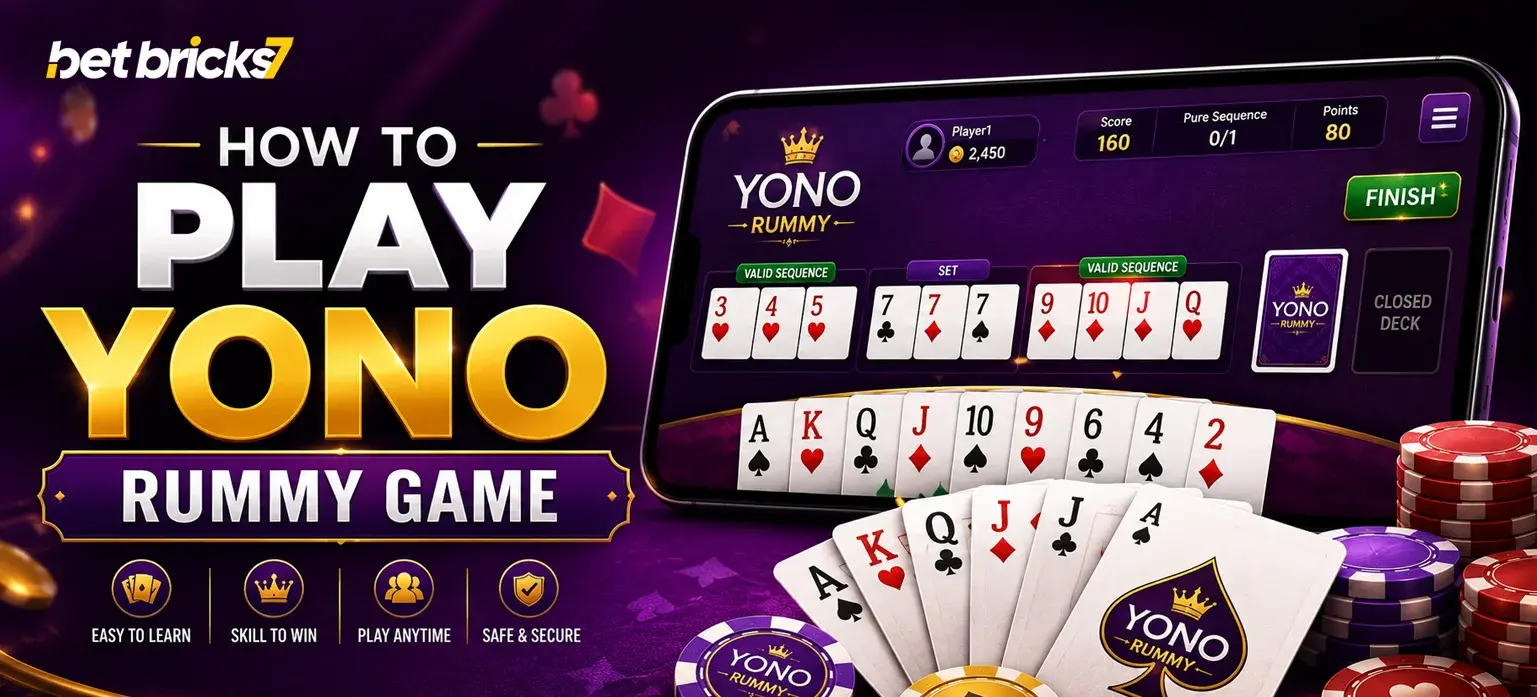
Knowing how to play the Yono Rummy game becomes easier if you know what goes on during each turn as opposed to learning just the rules. The game platform uses the conventional 13-card Indian Rummy format, where the goal is to organize all your cards into valid sequences and sets.
The growing interest in online rummy also reflects the broader expansion of India’s online gaming industry. According to the Press Information Bureau (Government of India), the Indian online gaming market generated ₹232 billion in 2024 and is projected to reach ₹316 billion by 2027, growing at an annual rate of 11%. This steady growth highlights the increasing popularity of skill-based card games among Indian players. In this article, you’ll learn how to play Yono Rummy and avoid common mistakes.
What Is Yono Rummy?
Yono Rummy is an online platform that offers skill-based Indian rummy games. The gameplay follows the standard 13-card Indian Rummy rules used across most online rummy platforms. So understanding these rules will help even if you switch between different apps later.
Here are the main features of how the game works:
- Every player is dealt 13 cards at the beginning of each round.
- One random card is selected as the Wild Joker, while the Printed Joker also remains available.
- You must form at least two sequences, and one of them must be a pure sequence.
- The remaining cards can be arranged into valid sequences or sets.
- The first player to submit a valid declaration wins the round.
- Each turn consists of drawing one card and discarding one card, keeping your hand at 13 cards throughout the game.
Although the objective sounds simple, the challenge lies in deciding which cards to keep, which cards to discard, and when your hand is complete enough to declare without making a mistake.
How a Standard Yono Rummy Game Works
Every round follows the same sequence of actions. Once you understand this flow, it becomes much easier to follow the game even during fast-paced tables.
Standard Yono Rummy Gameplay Flow
| Stage | What Happens |
| Card Distribution | Every player receives 13 cards. |
| Wild Joker Selection | One random card rank becomes the Wild Joker for that game. |
| First Turn | The starting player draws one card from either the Closed Deck or the Open Deck. |
| Card Arrangement | Players organise cards into possible sequences and sets |
| Discard | One unwanted card is discarded after every turn |
| Continuous Play | Every player repeats the draw-and-discard cycle until someone completes all combinations. |
| Declaration | A player declares after arranging all 13 cards into valid groups. |
| Verification | The system automatically checks whether the declaration satisfies the required rules. |
| Winner Announcement | A valid declaration wins the round. Invalid declarations receive penalty points |
Understanding the Three Card Groups You Must Know
Every winning hand is built using only three types of card combinations. Once you can identify them quickly, arranging your cards becomes much easier during the game.
The sections below explain how each combination works, along with examples that show why they are considered valid.
1. Pure Sequence
A pure sequence is the most important combination in Indian Rummy because every valid declaration must contain at least one.
Here’s what makes a pure sequence valid:
- Three or more consecutive cards
- Same suit throughout
- No Printed Joker or Wild Joker used
Example
- 5♠ 6♠ 7♠
- 9♦ 10♦ J♦ Q♦
Both examples are valid because every card belongs to the same suit and appears in consecutive order. Once you complete your pure sequence, you can use the remaining cards more freely while building other combinations.
2. Impure Sequence
An impure sequence also follows consecutive order, but it allows one or more missing cards to be replaced using a Joker.
The following examples show how this works:
- 7♣ 8♣ Joker 10♣
- Q♥ K♥ Joker
In the first example, the Joker represents 9♣. In the second example, it represents A♥. An impure sequence is perfectly valid, but it cannot replace the mandatory pure sequence required for declaration.
3. Set
A set groups cards by rank instead of consecutive order. All cards must have the same value while belonging to different suits.
For reference, a valid set looks like this:
- K♠ K♦ K♥
- 4♠ 4♣ 4♦ 4♥
Each card shares the same rank but comes from a different suit. Unlike sequences, the order of cards does not matter inside a set. However, duplicate suits are never allowed because a standard deck contains only one card of each suit.
Understanding the Joker
The Joker is one of the most useful cards in Yono Rummy, but many beginners use it incorrectly. It can help complete missing combinations, yet it cannot replace every card in your hand. Knowing where a Joker can and cannot be used helps you avoid invalid declarations.
1. Printed Joker
A Printed Joker is already included in the deck and remains the same in every game.
Here’s how it works in a hand:
- Can replace any missing card in a set or an impure sequence.
- Carries 0 penalty points if it remains in your hand.
- Cannot be used to create the mandatory pure sequence.
Example
Hand: 8♣ 9♣ Printed Joker J♣
Here, the Printed Joker represents 10♣, making it a valid impure sequence. Using a Printed Joker wisely often helps you complete difficult combinations without waiting for one specific card.
2. Wild Joker
Before every game begins, the platform randomly selects one card rank as the Wild Joker.
To understand this better, consider the following example:
- Suppose 5♦ is selected as the Wild Joker.
- Then 5♠, 5♥, 5♣, and 5♦ all become Wild Jokers for that game.
Example
Hand: 10♥ J♥ 5♣ K♥
Since 5♣ is the Wild Joker, it represents Q♥, creating a valid impure sequence. The Wild Joker changes with every game, so always check the selected card before planning your combinations.
Understanding Your Turn With an Example
Every turn in Yono Rummy follows the same pattern. You draw one card, arrange your hand if needed, and discard one card before ending your turn.
Consider this example hand:
- 4♥ 5♥ 6♥
- 8♣ 8♦
- Q♠ Q♥
- Wild Joker
- Remaining unmatched cards
Now imagine the top card in the Open Deck is 8♥.
Option 1: Pick from the Open Deck
By taking 8♥, you immediately complete this set:
- 8♣
- 8♦
- 8♥
You already know this card improves your hand, so there is very little risk.
Option 2: Pick from the Closed Deck
Instead of taking the visible card, you choose a random card from the Closed Deck.
You might receive:
- 7♥, which helps build another sequence.
- A♠, which does not fit anywhere.
This option involves uncertainty but sometimes leads to stronger combinations that other players cannot predict.
Your decision should depend on the current state of your hand rather than choosing the same option every turn.
Common Mistakes Beginners Make
Most losing hands are not caused by bad cards. They happen because players overlook small rule details while trying to finish quickly. Beginners often focus on collecting matching cards instead of checking whether those cards satisfy the declaration rules.
Some of the most common mistakes include:
- Declaring without completing a pure sequence.
- Treating an impure sequence as a pure sequence.
- Holding Kings, Queens, and Aces even when they do not fit into any combination.
- Breaking an already completed sequence to create another set.
- Forgetting to discard a card after drawing.
- Ignoring useful cards available in the Open Deck.
- Keeping too many Jokers instead of completing existing groups.
Most online platforms verify your declaration automatically. However, the system only checks after you declare, so an invalid declaration still results in penalty points. Spending a few extra seconds reviewing your hand is usually better than declaring too early.
How Scoring Works in Yono Rummy
Understanding the scoring system helps you decide which cards are worth keeping during the game. High-value cards can quickly increase your penalty if another player declares first.
Standard Card Values in Yono Rummy
| Card Type | Points |
| Ace | 10 |
| King | 10 |
| Queen | 10 |
| Jack | 10 |
| Number Cards (2–10) | Face Value |
| Printed Joker | 0 |
| Wild Joker | 0 |
Example of Penalty Calculation
Suppose another player declares before you, and your unmatched cards are:
- K♠ = 10 points
- Q♦ = 10 points
- 9♣ = 9 points
- 6♥ = 6 points
Your total penalty becomes:
10 + 10 + 9 + 6 = 35 points
This explains why skilled players usually discard high-value cards that are unlikely to become part of a sequence or set.
2026 Industry Insight
A 2026 research paper published on arXiv analysed Classic Indian Rummy as a game involving probabilistic decision-making and combinatorial optimisation. The study found that successful play depends heavily on choosing the right draw and discard actions rather than relying only on the cards dealt at the start of the game.
Understanding a Valid Declaration
A declaration is accepted only when every card in your hand follows the required grouping rules. Even one incorrect combination causes the declaration to fail.
Before declaring, confirm the following:
- Your hand contains 13 cards.
- You have at least two sequences.
- One sequence is a pure sequence.
- Every remaining card belongs to a valid sequence or set.
Example of a Valid Declaration
Pure Sequence
- 5♥ 6♥ 7♥
Impure Sequence
- 9♠ 10♠ Wild Joker Q♠
Set
- K♣ K♦ K♥
Set
- 3♣ 3♦ 3♥
This hand satisfies every rule because it contains one pure sequence, one impure sequence, and two valid sets.
Example of an Invalid Declaration
Consider this hand:
- 7♦ Wild Joker 9♦
- 10♠ J♠ Q♠
- 5♣ 5♦ 5♥
- A♣ A♦
Although it contains two groups that look like sequences, the first sequence uses a Joker. That means there is no pure sequence, making the declaration invalid.
Checking your pure sequence first is one of the easiest ways to avoid declaration errors.
Different Game Formats Available
Yono Rummy generally offers multiple game formats based on the standard Indian Rummy rules. While the card combinations remain the same across all formats, the way winners are decided is different. Understanding these formats helps you choose one that matches the amount of time you want to spend on the game.
1. Points Rummy
Points Rummy is the quickest format because every game ends as soon as one player makes a valid declaration. It is often preferred by beginners as there is only one round to focus on. This makes it easier to understand card grouping and scoring.
Here’s what defines this format:
- Every player receives 13 cards.
- The game ends after one valid declaration.
- Each penalty point has a fixed value decided before the game starts.
- Your final score depends on the unmatched cards left in your hand.
Example
Suppose the table value is ₹1 per point. If you finish with 18 penalty points, the deduction is based on those 18 points according to the table rules. Since every round is short, this format allows you to play multiple games and improve your decision-making quickly.
2. Pool Rummy
Pool Rummy focuses on consistency rather than winning a single round. Instead of ending after one declaration, players continue playing until they cross a predefined penalty limit.
The main rules are as follows:
- The pool usually has a 101-point or 201-point limit.
- Penalty points are added after every round.
- Players who reach the maximum point limit are eliminated.
- The last remaining player wins the game.
Example
Suppose a player scores:
- Round 1 = 20 points
- Round 2 = 14 points
- Round 3 = 27 points
The cumulative score becomes 61 points. The player stays in the game because the elimination limit has not yet been reached.
Pool Rummy rewards careful play because one poor round can affect your standing in the following rounds.
3. Deals Rummy
Deals Rummy is played for a fixed number of rounds. Instead of eliminating players, the platform compares the total scores after all deals have been completed.
The format generally works like this:
- The number of deals is fixed before the game starts.
- Common options include 2 Deals, 3 Deals and 6 Deals.
- Every player’s score is recorded after each deal.
- The player with the lowest cumulative score wins.
Example
Suppose a three-deal game ends with these scores:
| Deal | Player A |
| Deal 1 | 8 |
| Deal 2 | 15 |
| Deal 3 | 11 |
| Total | 34 |
If no other player finishes with a lower total than 34, Player A wins the game. Deals Rummy is a good option when you prefer consistent scoring instead of depending on a single round.
Choosing Between the Open Deck and Closed Deck
Every turn begins with one important decision: should you pick a visible card from the Open Deck or take a random card from the Closed Deck?
Open Deck vs Closed Deck
| Situation | Better Choice | Reason |
| The top discarded card completes your sequence | Open Deck | You immediately improve your hand with a known card. |
| The visible card does not help any combination | Closed Deck | A random card may fit your existing groups better. |
| You need one specific card to complete a set | Open Deck | Picking the visible card removes uncertainty. |
| You are still building multiple combinations | Closed Deck | Drawing blindly may provide more options without revealing your strategy. |
| Your hand is almost complete | Open Deck | Completing the final combination quickly reduces the risk of another player declaring first. |
Many skilled players spend only a few seconds making this decision because they already know which cards their hand still requires.
Practical Tips That Improve Your Winning Chances
Winning more games usually comes from making better decisions every turn rather than receiving stronger starting cards. After analysing hundreds of standard Indian Rummy hands, one pattern becomes clear: players who organise their cards early and manage penalty points carefully make fewer costly mistakes.
1. Complete Your Pure Sequence First
Your first priority should always be building the mandatory pure sequence. Every other combination becomes useless if this requirement is missing at the time of declaration. Once the pure sequence is complete, you can use Jokers more freely in the remaining combinations.
2. Arrange Your Cards After Every Draw
Many players wait until the end of the game before organising their cards. Rearranging your hand after every draw helps you spot new sequence opportunities immediately. It also reduces the chances of accidentally breaking a completed combination.
3. Keep Watching the Open Deck
The discarded cards provide useful information about what your opponents may be collecting. For example, if several Heart cards appear in the Open Deck, the probability of completing a long Heart sequence becomes lower. This information helps you decide whether to continue waiting for a particular card or
3. Keep Watching the Open Deck
The discarded cards provide useful information about what your opponents may be collecting. For example, if several Heart cards appear in the Open Deck, the probability of completing a long Heart sequence becomes lower. This information helps you decide whether to continue waiting for a particular card or change your strategy.
4. Discard High-Value Cards That Do Not Fit
Holding Kings, Queens and Aces without a clear purpose increases your penalty score if another player declares first. Unless these cards are already contributing to a sequence or set, they often become a liability. Replacing them with lower-value cards can reduce your overall risk.
5. Use Jokers Where They Save the Most Turns
A Joker should replace the hardest card to obtain instead of the first missing card you notice. For example, if two different combinations need one card each, use the Joker on the combination that has fewer natural alternatives. This approach improves the overall flexibility of your hand.
6. Avoid Declaring Immediately After Completing Your Hand
Take a final look at every group before pressing the declaration button. Verify that your pure sequence is still intact and that every remaining card belongs to a valid sequence or set. Spending five extra seconds reviewing your hand is often better than receiving penalty points for an invalid declaration.
Conclusion
Learning how to play the Yono Rummy game becomes much easier once you understand the logic behind every move instead of relying on trial and error. Your first goal should always be completing a pure sequence. After that, focus on building the remaining sequences and sets while keeping your penalty points as low as possible. Paying attention to the Open Deck, using Jokers carefully, and checking your hand before declaring can improve your decisions over time.
Betbricks7 offers Indian Rummy alongside other online gaming options, but regardless of the platform you choose, understanding the official rules, practising regularly, and making calculated draw-and-discard decisions will always have a greater impact on your results than depending only on the cards you are dealt.
Frequently Asked Questions
1. How many cards are dealt to each player in Yono Rummy?
Each player receives 13 cards at the beginning of a standard Indian Rummy game. Your objective is to arrange all 13 cards into valid sequences and sets before making a valid declaration.
2. Is a pure sequence compulsory in Yono Rummy?
Yes. A pure sequence is mandatory. Even if all your remaining cards form valid sets or impure sequences, your declaration will be rejected if you do not have at least one pure sequence.
3. Can I use a Joker in every sequence?
No. A Printed Joker or Wild Joker can only be used in an impure sequence or a set. It cannot be used to create the mandatory pure sequence required for a valid declaration.
4. What happens if I make an invalid declaration?
When you make an invalid declaration, the platform verifies your hand automatically and applies the applicable penalty according to the game rules. This usually happens when a pure sequence is missing or one or more cards are not arranged into valid combinations. Reviewing your hand before declaring helps avoid this mistake.